
Translatomics for Protein Folding, Hidden ORFs and Drug Response

Recent Publications Harnessing the Power of Translatomics
Every week we provide a digest of a small number of recent interesting papers in the field of translatomics.
In this week’s Sunday papers,
- Till et al. show that trigger factor promotes nascent-chain compaction and folding during translation.
- Troian et al. identify 96 previously unannotated ORFs, many encoding small proteins, highlighting alternative approaches for exploring the bacterial dark proteome.
- Wei et al. show that Csm6-mediated RNA cleavage reduces polysome association and global translation, increasing bacterial susceptibility to antibiotic treatment.
Trigger factor accelerates nascent chain compaction and folding
PNAS, 2025
Katharina Till, Anne-Bart Seinen, Florian Wruck, Vanda Sunderlikova, Carla V. Galmozzi, Alexandros Katranidis, Bernd Bukau, Günter Kramer, Sander J. Tans
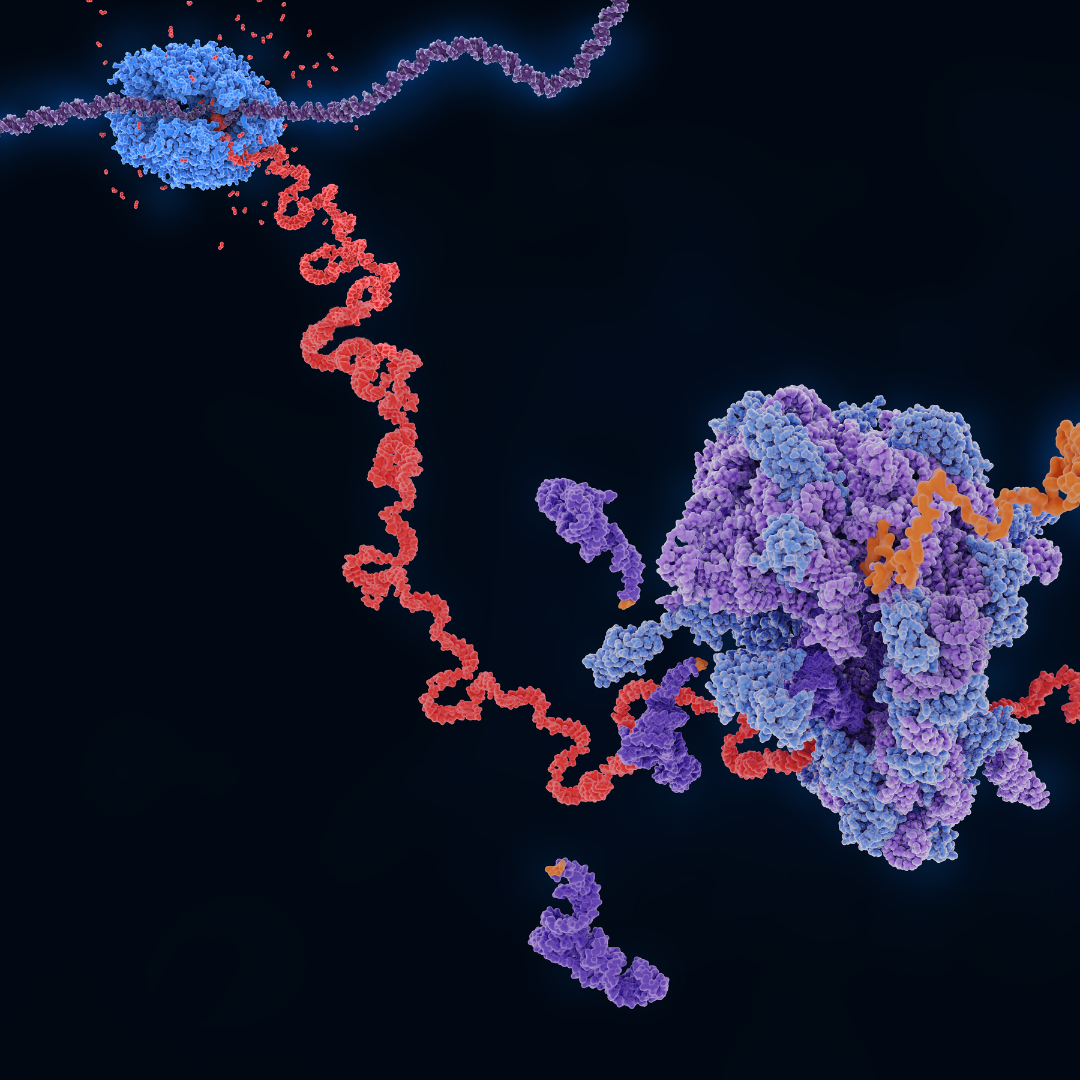
Protein folding begins before translation is complete, as newly synthesised polypeptides emerge progressively from the ribosomal exit tunnel. The bacterial chaperone trigger factor (TF) interacts with translating ribosomes, but how it influences the physical folding of nascent chains has remained unclear. This study combines selective ribosome profiling (SeRP) with single-molecule biophysical approaches to investigate this process in Escherichia coli.
Using dihydrofolate reductase (DHFR) as a model substrate, SeRP was used to map where TF associates with nascent chains during translation. TF association was initially low but increased after around 75 residues had been translated, becoming more prominent later in translation. Optical tweezers and correlated single-molecule fluorescence were then used to examine how TF binding affects nascent-chain conformation. These experiments showed that TF promotes compaction of the nascent chain and stabilises partially folded states. In turn, more compact nascent chains showed longer TF binding times, revealing a reciprocal relationship between TF binding and co-translational folding.
The study provides a mechanistic view of cotranslational protein folding, linking ribosome-associated chaperone recruitment with the structural maturation of a nascent protein. For Ribo-seq applications, it demonstrates how specialised ribosome profiling can be adapted beyond measuring translation itself to investigate ribosome-associated factors and cotranslational regulation.
Learn more about EIRNABio’s ribosome profiling services here.
Harnessing toxin-mediated ribosome stalling as a complementary tool to annotate bacterial ORFs
Nucleic Acids Research, 2026
Eduardo A. Troian, Valdir C. Barth, Unnati Chauhan, Haiyan Zheng, Caifeng Zhao, Jumei Zeng, Robert N. Husson, Nancy A. Woychik

Accurate identification of protein-coding genes remains difficult in bacterial genomes, particularly for small open reading frames (sORFs) that can fall below conventional gene-annotation thresholds. Ribosome profiling can provide direct evidence of translation, but this study investigates a complementary strategy based on toxin-induced ribosome stalling to uncover previously unannotated ORFs.
The authors exploit VapC4, a toxin from Mycobacterium tuberculosis that cleaves tRNACys. Depletion of cysteine tRNA causes ribosomes to stall at cysteine codons, producing characteristic RNA cleavage signatures. Using specialised 5′-OH RNA-seq, the authors use these signatures to identify translated ORFs without performing conventional Ribo-seq. The approach uncovered 96 previously unannotated ORFs, with 54% predicted to encode proteins of 50 amino acids or fewer. The candidates included potential regulatory sORFs, including Cys-responsive attenuators, as well as sequences predicted to encode stable small proteins. Previously published Ribo-RET datasets provided an independent source of evidence for translation and helped refine translation-start assignments.
The study demonstrates how toxin-mediated ribosome stalling signatures can complement Ribo-seq-based ORF discovery, particularly for small and previously overlooked coding regions. This makes the approach relevant to the identification of translated ORFs and the dark proteome, while highlighting the value of combining different forms of ribosome-derived evidence to improve genome annotation.
Learn more about EIRNABio’s ribosome profiling services here.
CARF-dependent preferential RNA cleavage by Csm6 increases drug susceptibility of mycobacteria
Nucleic Acids Research, 2025
Wenping Wei, Chun-Hui Gao, Xiaofang Jiang, Junjie Qiao, Li Zhang, Yunjun Yan, Guowei Zhao, Kaixin Yang, Jinyong Yan, Min Yang
CRISPR-Cas systems are best known for protecting bacteria from foreign genetic material, but some CRISPR-associated proteins can also influence bacterial physiology. This study investigates Csm6, an RNA nuclease associated with the type III-A CRISPR-Cas system and examines how its RNA-cleavage activity affects translation and drug susceptibility in mycobacteria.
The authors expressed Mycobacterium tuberculosis Csm6 in M. smegmatis and combined RNA-seq with biochemical and functional experiments to examine its effects on host transcripts. Csm6 expression preferentially reduced transcripts associated with ribosomal protein production and mycolic acid biosynthesis, with 49 of 64 annotated ribosome-pathway genes significantly downregulated. Mutational analysis further showed that this phenotype depended strongly on the CARF domain of the protein.
Importantly, polysome profiling was used to determine whether these transcript-level changes were accompanied by altered protein-synthesis activity. Sucrose-gradient fractionation showed a substantial reduction in polysome abundance relative to monosomes in Csm6-expressing cells, with the polysome/monosome ratio approximately half that of the control. This demonstrates that Csm6-mediated RNA cleavage is associated with reduced ribosome loading and impaired global translation, rather than simply altering transcript abundance.
The resulting translational disruption was associated with compromised cellular integrity and increased susceptibility to antibiotics including isoniazid and rifampicin. The study therefore connects RNA cleavage, reduced ribosome loading, impaired translation and drug susceptibility, illustrating how polysome profiling can add a functional translational layer to transcriptomic analysis.
Learn more about EIRNABio’s polysome profiling services here.