
Understanding Differential Codon Decoding Analysis
Not all codons are decoded at the same rate
Not all codons are decoded at the same rate; some are translated quickly, while others may cause ribosomes to pause or move slower. These differences in decoding rates can be influenced by factors such as codon sequence, tRNA abundance and mRNA structure.
Ribosome profiling (Ribo-seq) maps the positions of ribosomes on mRNA transcripts, providing insight into translation dynamics. By sequencing the ribosome-protected fragments (RPFs) of mRNA, it allows the rate at which ribosomes decode specific codons during protein synthesis to be measured. Ribo-seq can identify variations in decoding rates across different codons, highlighting regions of mRNA that may experience slower or faster translation, and provide insights into translational regulation, mRNA stability, and protein production control.
Understanding Differential Codon Decoding Analysis
Differential codon decoding rates refers to the comparison of the variation in the speed or efficiency between groups with which ribosomes translate different codons during protein synthesis. This analysis may be conducted for both codons of the ribosome A-site and P-site. Understanding the differences in rates helps reveal how translation is regulated and how certain sequences or regions in mRNA may impact protein production, folding, and function.
The EIRNA Bio Connect Approach for differential decoding analysis
Case study using Ribo-seq data from Sieber et al., (2024)1

Figure 1 Differential codon occupancy plot as implemented on the Connect platform using Ribo-seq data generated for Sieber et al., 20241. The Ribo-seq occupancy at the P-site for the codons that encode the Proline amino acid (highlighted in pink) is higher in the E. coli strain that lacks the elongation factor EF-P compared to the wild type (WT) strain..
Proline plays a unique role in translation regulation due to its rigid pyrrolidine ring, which slows down peptide bond formation. This property makes proline-rich sequences, a major cause of ribosome stalling during translation2. Elongation Factor P (EF-P) is a bacterial translation elongation factor that helps ribosomes overcome stalling at polyproline sequences1.
The EIRNA Bio Connect differential codon occupancy functionality using Ribo-seq data generated for an E.coli strain that lacks EF-P compared to wild type (Sieber et al., 20241) shows that proline codons are critical determinants of ribosome stalling (Figure 1). The analysis can be carried out at the codon level (Figure 1), amino acid level (Figure 2) and at the di-amino acid level (Figure 3). Sieber et al., (2024)1 reported that ribosome profiling revealed that XP(P)X motifs, particularly those with a guanosine at the first position of the E-site codon, strongly influence stalling. EF-P and its paralog EfpL, alleviate stalling but can also induce translational pauses. Sequences with consecutive prolines (e.g., polyproline stretches) exacerbate stalling (Figure 3).
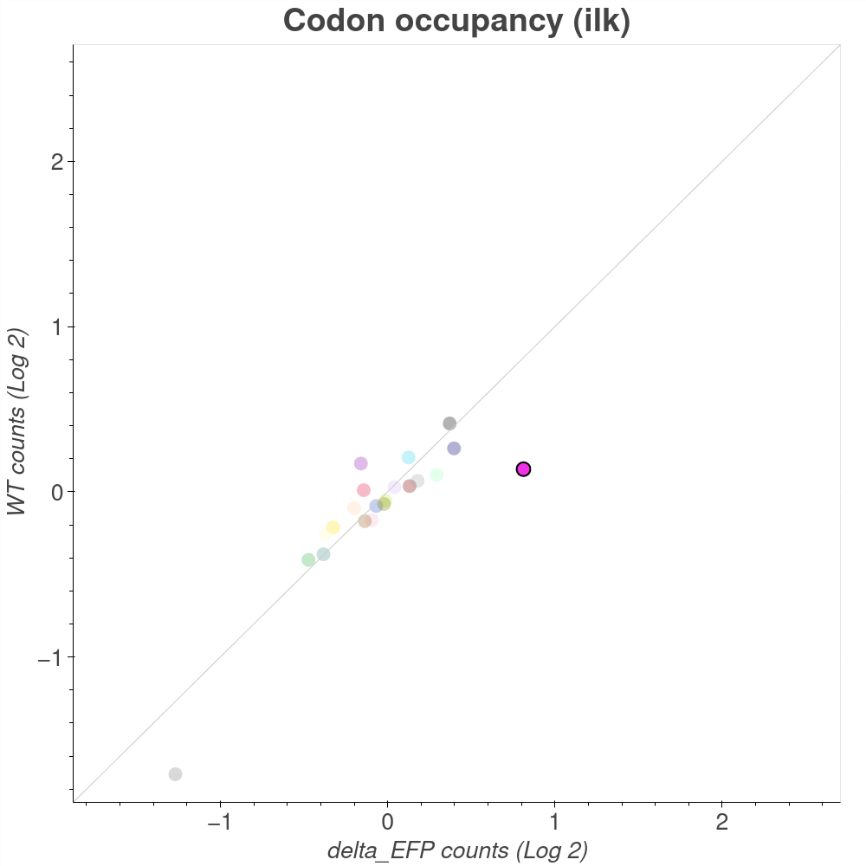
Figure 2 Differential amino acid occupancy plot as implemented on the Connect platform using Ribo-seq data generated for Sieber et al., 20241. The Ribo-seq occupancy at the P-site for the codons that encode the Proline amino acid (highlighted in pink) is higher in the E. coli strain that lacks the elongation factor EF-P compared to the wild type (WT) strain.
Applications and Implications
Understanding differential decoding rates through ribosome profiling has significant applications and implications in fundamental biology, disease research, and drug development. Examples include identifying which codons are translated slowly or rapidly, providing insights into rate-limiting steps in protein synthesis. It enables the study of co-translational folding, where slower translation at specific sites may allow correct protein folding3. Ribosome velocity and protein folding play key roles in Cystic fibrosis4. In biomanufacturing, tuning codon usage based on decoding rates can enhance recombinant protein yields in bacterial or mammalian expression systems5. Ribosome profiling has been utilized to study translational changes in various cancers, uncovering how differential decoding rates contribute to tumorigenesis. For instance, this technique has identified cancer-specific alterations in translation that promote the synthesis of proteins involved in cell proliferation and survival6.
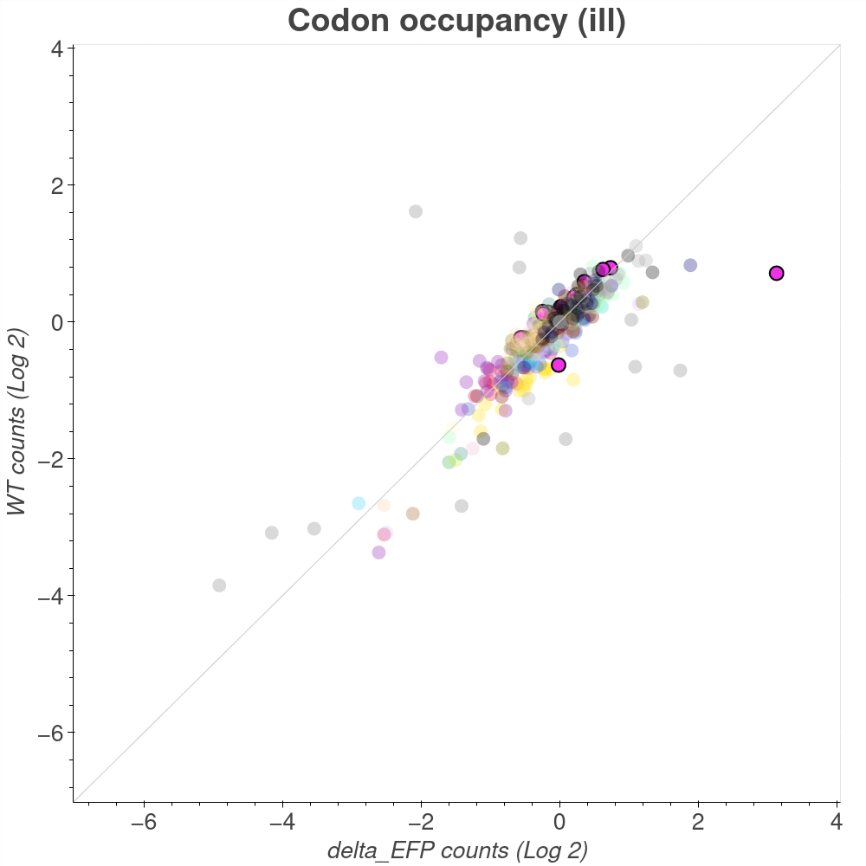
Figure 3 Differential di-amino acid occupancy plot as implemented on the Connect platform using Ribo-seq data generated for Sieber et al., 20241. The P-site Ribo-seq occupancy at two consecutive amino acids where the first amino acid represents Proline are highlighted in pink. The RPF occupancy at the di-amino Proline-Proline motif is higher in the E. coli strain that lacks the elongation factor EF-P compared to the wild type (WT) strain.
Challenges and Future Directions
Despite its immense potential, using Ribo-seq for differential codon decoding rate analysis poses computational and experimental challenges, including the normalization of data sets and the interpretation of results. EIRNA Bio Connect is a unique browser-based platform that enables codon occupancy analysis at the click of a button without the need for prior bioinformatic experience.
Conclusion
Ribo-seq is a powerful tool for analysing codon decoding rates, providing high-resolution insights into translation dynamics7. By capturing ribosome footprints, it reveals variations in elongation speed, ribosome pausing, and codon-specific translation efficiency. This information is crucial for understanding gene regulation, optimizing recombinant protein expression, and uncovering disease-related translational defects. Ultimately, ribosome profiling enhances our ability to fine-tune codon usage for therapeutic and biotechnological applications while shedding light on fundamental aspects of cellular protein synthesis.
Stay tuned for how EIRNA Bio Connect can provide actionable insights for your own data.
Over the course of the coming months, we will highlight additional EIRNA Bio Connect functionality to illustrate how our interactive platform can help advance your own research questions.
- 1. Sieber A, Parr M, von Ehr J, Dhamotharan K, Kielkowski P, Brewer T, Schäpers A, Krafczyk R, Qi F, Schlundt A, Frishman D, Lassak J. EF-P and its paralog EfpL (YeiP) differentially control translation of proline-containing sequences. Nat Commun. 2024 Dec 2;15(1):10465. doi: 10.1038/s41467-024-54556-9
- Krafczyk R, Qi F, Sieber A, Mehler J, Jung K, Frishman D, Lassak J. Proline codon pair selection determines ribosome pausing strength and translation efficiency in bacteria. Commun Biol. 2021 May 17;4:589. doi: 10.1038/s42003-021-02115-z
- Waudby CA, Dobson CM, Christodoulou J. Nature and Regulation of Protein Folding on the Ribosome. Trends Biochem Sci . 2019 Nov;44(11):914–926. doi: 10.1016/j.tibs.2019.06.008
- Oliver KE, Rauscher R, Mijnders M, Wang W, Wolpert MJ, Maya J, Sabusap CM, Kesterson RA, Kirk KL, Rab A, Braakman I, Hong JS, Hartman 4th JL, Ignatova Z, Sorscher EJ. Slowing ribosome velocity restores folding and function of mutant CFTR. J Clin Invest. 2019 Dec 2;129(12):5236-5253. doi: 10.1172/JCI124282.
- Mauro VP. Codon Optimization in the Production of Recombinant Biotherapeutics: Potential Risks and Considerations. BioDrugs .2018 Feb;32(1):69-81. doi: 10.1007/s40259-018-0261-x
- Su D, Ding C, Qiu J, Yang G, Wang R, Liu Y , Tao J , Luo W, Weng G, Zhang T. Ribosome profiling: a powerful tool in oncological research. Biomark Res. 2024 Jan 25;12(1):11. doi: 10.1186/s40364-024-00562-4
- Michel AM, Baranov PV. Ribosome profiling: a Hi-Def monitor for protein synthesis at the genome-wide scale Wiley Interdiscip Rev RNA . 2013 May 20;4(5):473–490. doi: 10.1002/wrna.1172